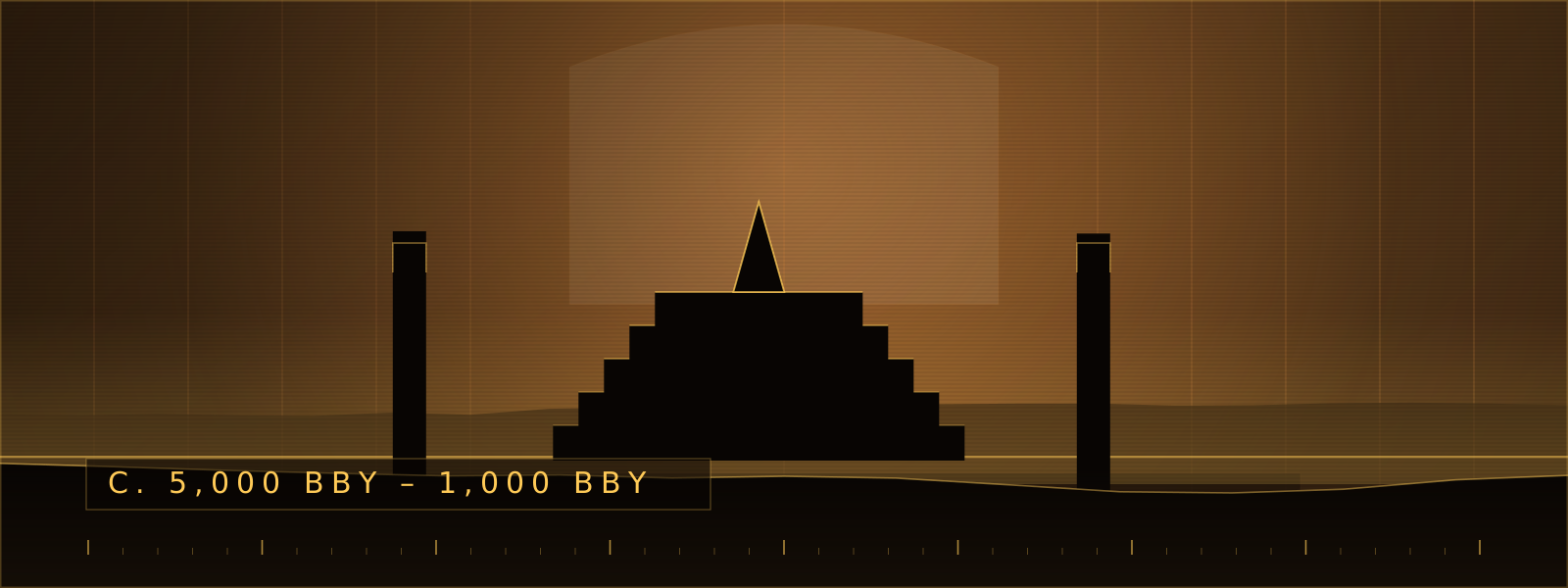
The Old Republic is the era where Star Wars stopped being a story about one family and became a history. It runs roughly four millennia, it contains at least six galaxy-scale wars, and it is built on a single repeating shape: the Sith find a way back, the Republic is nearly destroyed, the Jedi win at ruinous cost, and everyone agrees it can never happen again. It happens again.
The powers
Two institutions, both enormous and both fragile. The Galactic Republic in this period is not the sclerotic debating society of the prequels — it has fleets, it has an army, and it loses wars badly enough to have its capital sacked. The Jedi Order is larger, more militarised and far less centralised than it will later become, with academies on Ossus, Dantooine and elsewhere, and a chronic inability to tell the difference between a Knight with unconventional ideas and a Knight who is about to fall.
Against them, the Sith are not the two-person conspiracy of the films. They are an empire — with worlds, shipyards, an aristocracy and an academy system — and their recurring problem is not secrecy but ambition. Sith Lords in this era destroy themselves roughly as often as the Jedi destroy them.
The defining conflicts
Four are worth knowing before you read anything. The Great Hyperspace War (5,000 BBY) is the Sith Empire's first collision with the Republic and ends with the Empire apparently annihilated. The Great Sith War (3,996 BBY) is the fall of Exar Kun and Ulic Qel-Droma, told in Dark Horse's Tales of the Jedi, and it costs the Jedi Ossus. The Mandalorian Wars and the Jedi Civil War (3,976–3,956 BBY) are the Revan story — a Jedi who goes to war against his Council's orders, wins, disappears into the Unknown Regions and comes back as a Dark Lord. And the New Sith Wars grind on for something like a thousand years and end the era.
Where it lives in print
Mostly in comics and games rather than novels. Tales of the Jedi (Dark Horse, 1993 onward) established the period. BioWare's Knights of the Old Republic (2003) and Obsidian's The Sith Lords (2004) are the reason most people care about it at all, and Drew Karpyshyn's Revan (2011) and the Old Republic tie-in novels extend it. The MMO Star Wars: The Old Republic (2011) sits three centuries later still, after the Sacking of Coruscant.
Canon and Legends
This is the cleanest divide on the site: essentially all of the above is Legends. Lucasfilm added an official Old Republic era label to its chart, and the canon material set inside it remains very thin — the current continuity establishes that the Republic and the Jedi are ancient and that a Sith Empire once existed, without committing to Revan, Exar Kun, or any specific date. Nothing here has been contradicted so much as left unclaimed.
The practical consequence for a reader: treat the Old Republic as a self-contained library. It rewards that. It is the only part of Star Wars where the Jedi are allowed to be a genuinely alien religious order rather than a branch of the civil service, and where losing is a real possibility.
Chronologically the era closes at Ruusan, which hands directly to The Rule of Two.