
Garage door growth systems
One garage door company
doubled its monthly revenue
in seven months.
We started in mid-February. Same crew, same trucks, roughly the same ad budget. What changed was what they could see — and what started happening on its own, every day.
Built and run by

· 2026 Inc. Power Partner · (480) 741-8081
Completed revenue per month
$118,761
January 2026
the month before we started
$240,964
September 2026
seven months in
Up 103% — and 402 jobs completed in September against 285 in January.
2026 year to date
The year in four numbers
$1.78M
Completed revenue
Across 3,617 completed jobs, January through 28 October.
$11.37
Revenue per ad dollar
All completed revenue against all paid media: $156,169 spent.
5.0 ★
Google rating
Across 1,934 reviews — up from 1,899 in mid-August.
13,992
Calls logged
10,240 inbound, each one classified and attributable.
Read from production, 28 October 2026. Revenue is pre-tax, counted on completion.
Monthly completed revenue, thousands of dollars
2026 against 2025, month by month
2025
2026
January–October
$1.78M vs $1.17M
Up 52% year on year
114
119
Jan
123
150
Feb
161
164
Mar
122
190
Apr
130
160
May
92
177
Jun
112
189
Jul
93
209
Aug
128
241
Sep
90
175
Oct
We start here
mid-February
The lines separate
from mid-March
2026 read from the platform, 28 October; October is a partial month. 2025 supplied by the company from its own records.
Paid media
We did not buy the growth. We moved the money.
| Channel | 2025 full year | 2026 to date |
|---|---|---|
| Google Ads | $100,081 | $57,643 |
| Google Local Services | $42,433 | $98,526 |
| Total | $142,514 | $156,169 |
Google Ads cut 42%
The campaigns that were not producing booked jobs were turned off, not optimised forever.
Local Services up 2.3×
Charged-lead cost feeds the same spend table, so Local Services is held to the same cost per customer as everything else.
One spend table keyed by date, channel and campaign — manual and connector rows overwrite, never double-count.
affordabledoorco.com
The same site, built for the driveway and the desk
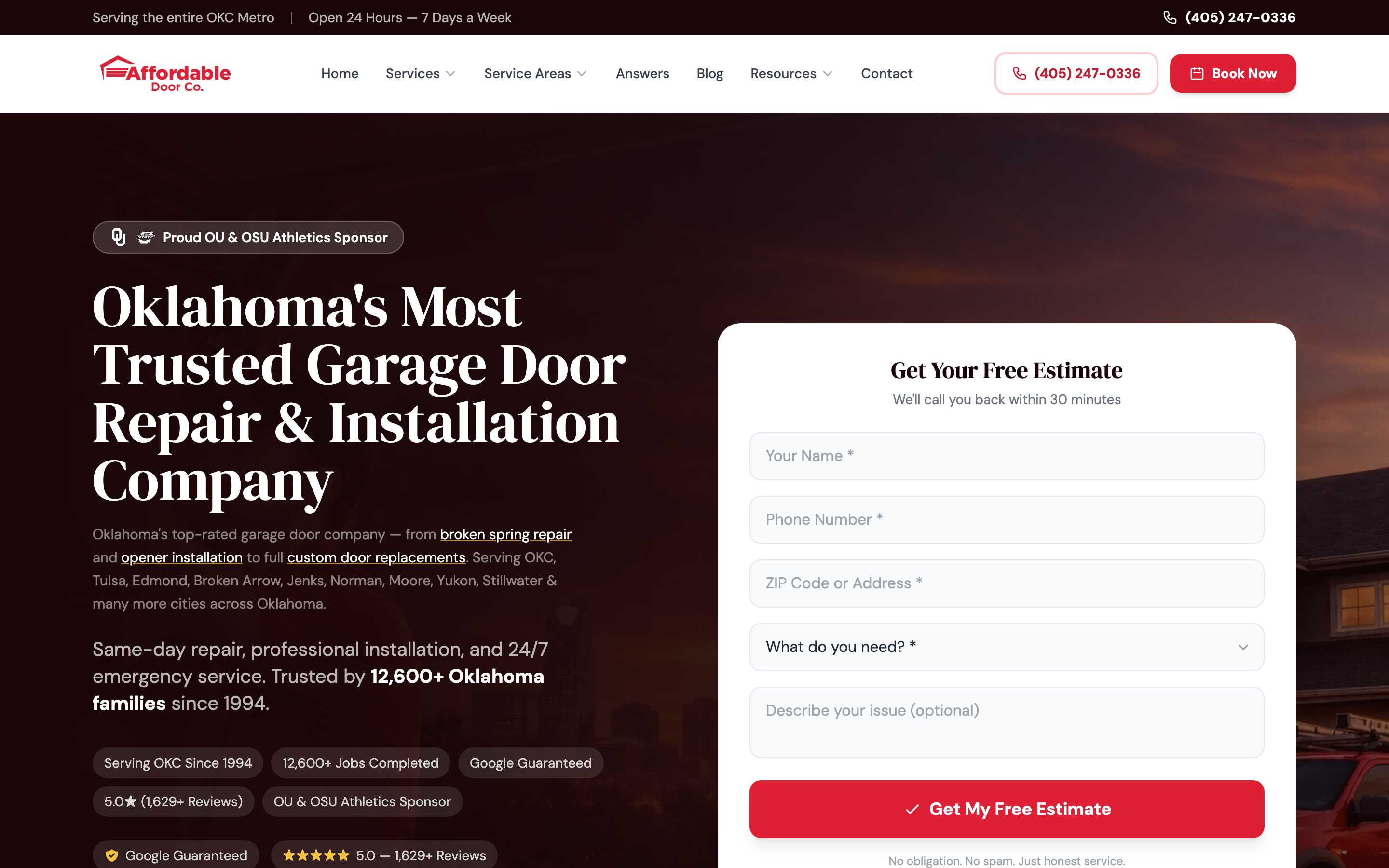

The phone is the primary screen
Most of these visitors are standing in front of a door that will not open. The number and the booking button are pinned to the bottom of every phone screen.
The estimate form is the hero
Not a carousel, not a video. Name, number, zip, what you need — beside a promise the company actually keeps.
Proof above the fold
5.0 stars, the review count, Google Guaranteed, since 1994 — the things a stranger needs before they will dial.
The live site, captured 31 October 2026. Chat and cookie widgets hidden for the screenshot only.
Live on the client's site today
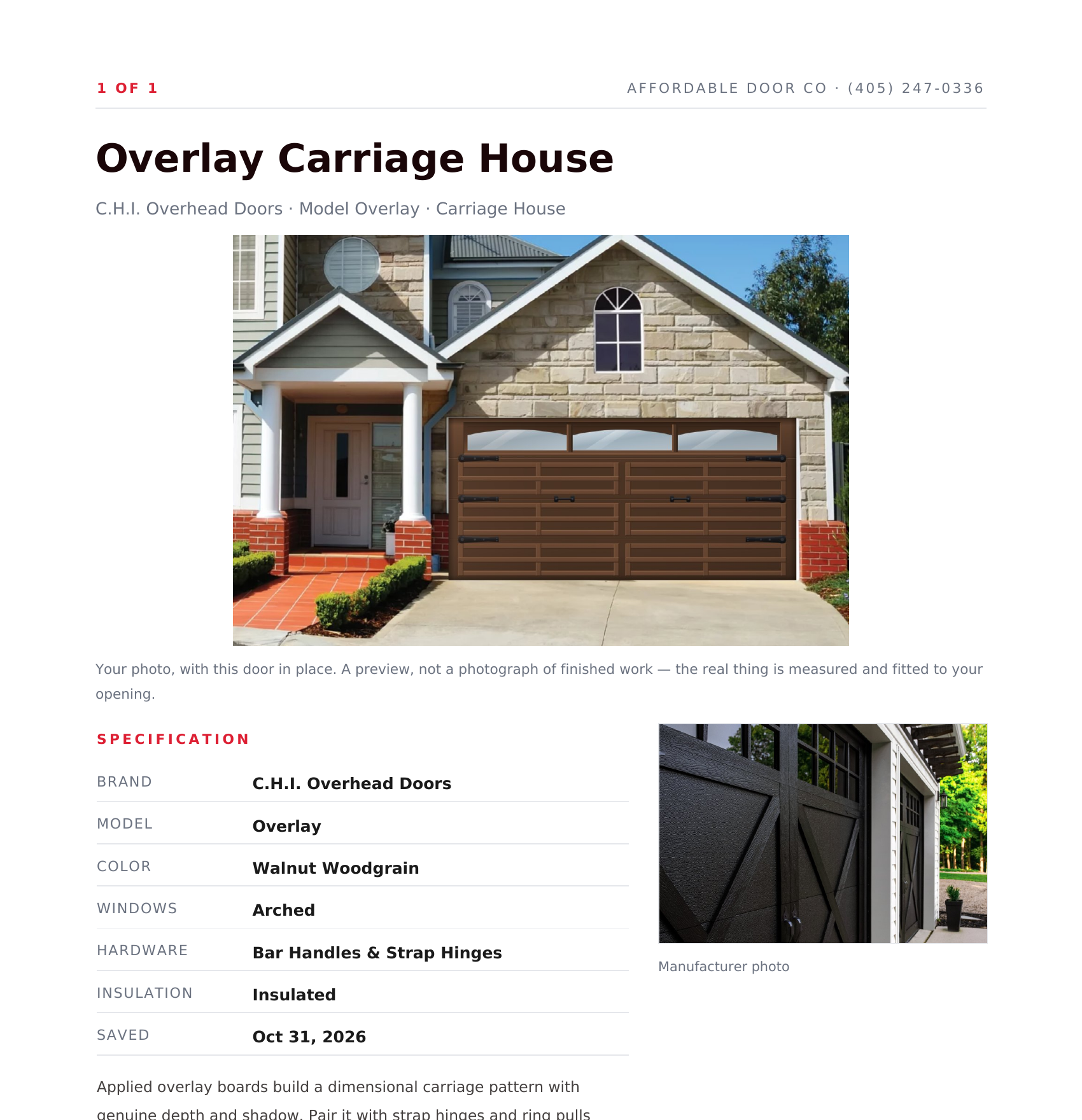
The Designer, and the document it produces
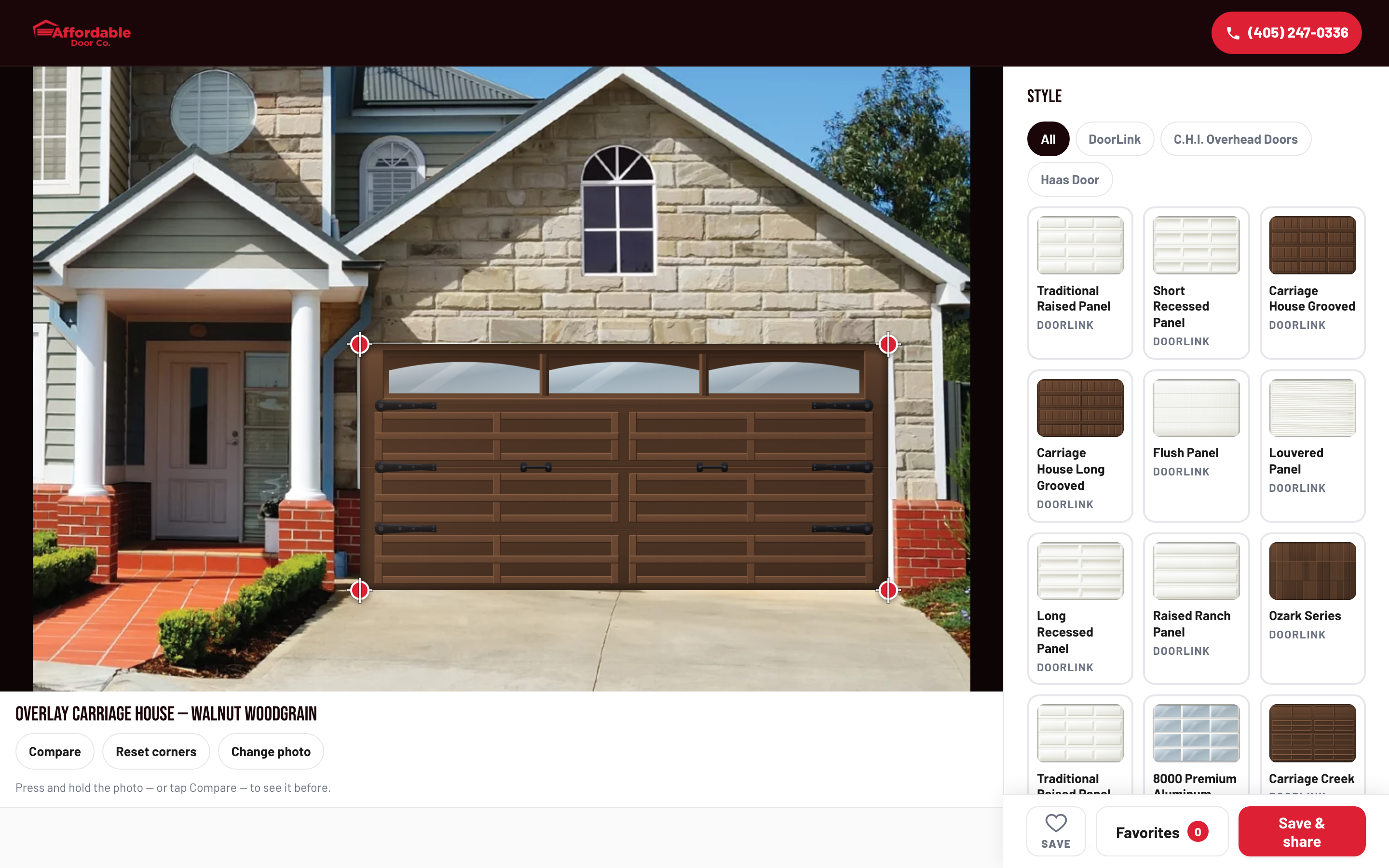
Their house, their driveway
A homeowner photographs their own garage on a phone and the door is warped onto the real opening — 26 styles, 18 colours, 15 openers.
It leaves as a document
Brand, model, colour, windows, hardware, insulation — so the estimate starts from a named door, not "something like that one".
No price anywhere in it
Cost depends on size, track, spring and install conditions, so every cost question routes to a free estimate instead.
The live application and its own PDF output, 31 October 2026. The house is the demo photo the app ships; no customer's photo or details were used.
The website
Built to answer the question, then book the job
314
core pages
Services, brands, financing, coupons, estimate and booking flows.
331
expert answers
Springs, openers, cost drivers, weather, insulation, commercial, gates.
210
blog posts
Rebuilt from the ground up, and still being added to weekly.
24
cities and towns
Each with its own service pages, plus 78 named neighbourhood pages across the metro.
Structured data on every page, an index written for AI assistants, instant search-engine submission on publish, and analytics wired to the same platform that measures the phone calls — so a lead traces back to the page or offer that produced it.
878 pages published in total, counted from the site’s own sitemaps on 31 October 2026. Search-ranking results are deliberately not claimed.
The Answer Hub
331 answers to the questions people actually type
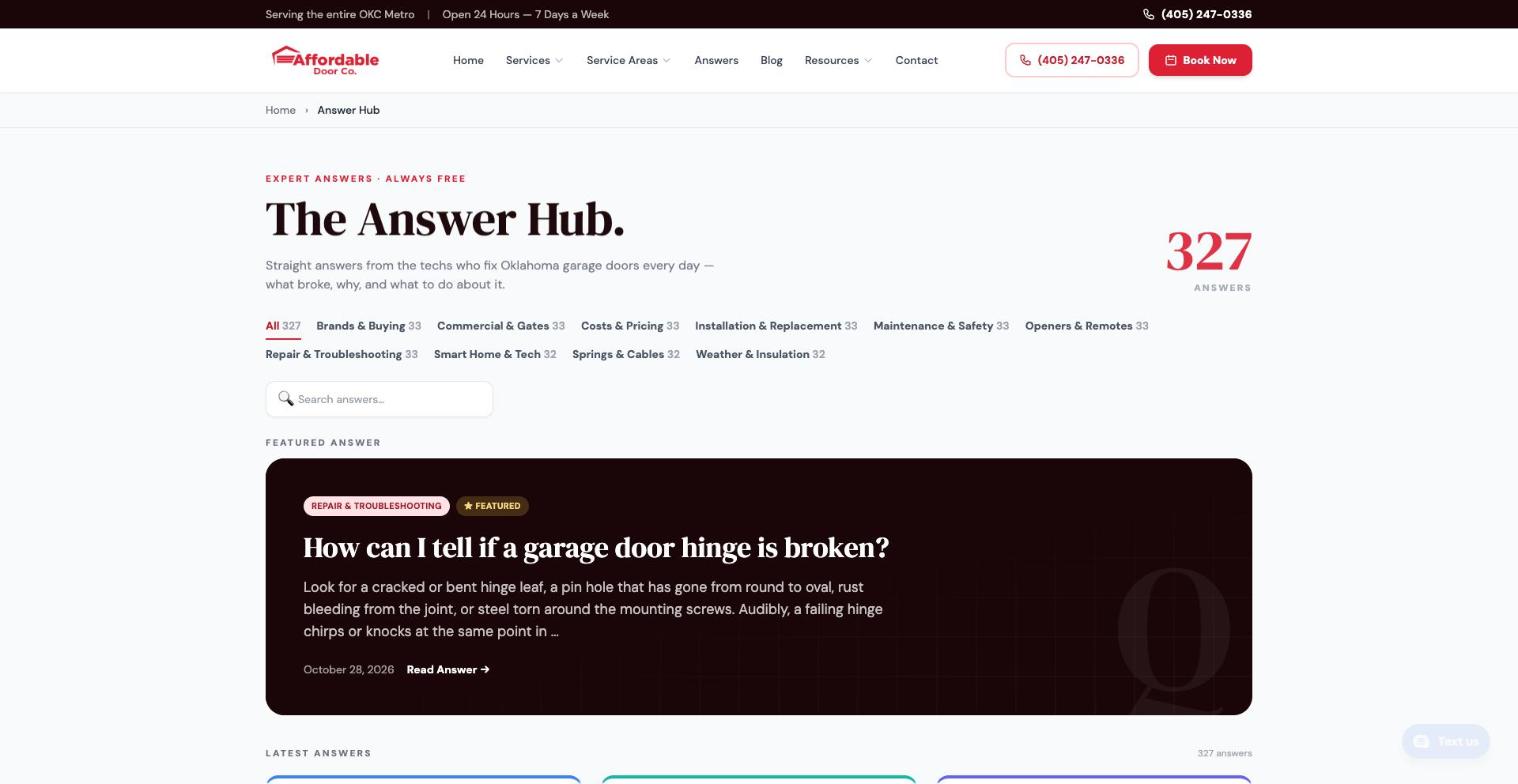
Somebody whose spring broke at 10pm does not search for a company — they search for a question. Every one of those questions gets a real page: what it costs to fix, whether it is safe to use, what the noise means, how long it lasts.
442
written
331
published
0
prices quoted
Published on a drip, not dumped
The site's sitemap is date-filtered, so an answer written today is invisible until its publish date comes up. A hundred new pages appearing overnight is a pattern; a few a day is a library.
Published count read from the site's own sitemap, 31 October 2026. Search-ranking results are deliberately not claimed.
The blog and the finished work
Every job done becomes a page, a post and a photo
A finished install is photographed on the truck. From that one job the system writes a recent-work page with the city and the service on it, a Facebook post, and a Google Business post — and the photos are geotagged and renamed from the real job before any of it goes out.
210
blog posts live
23
recent-work pages
299
jobs queued to post
The search engines are told the moment it publishes
New and changed pages are submitted on publish rather than waiting to be crawled, and each one carries structured data plus an entry in the site's index for AI assistants.
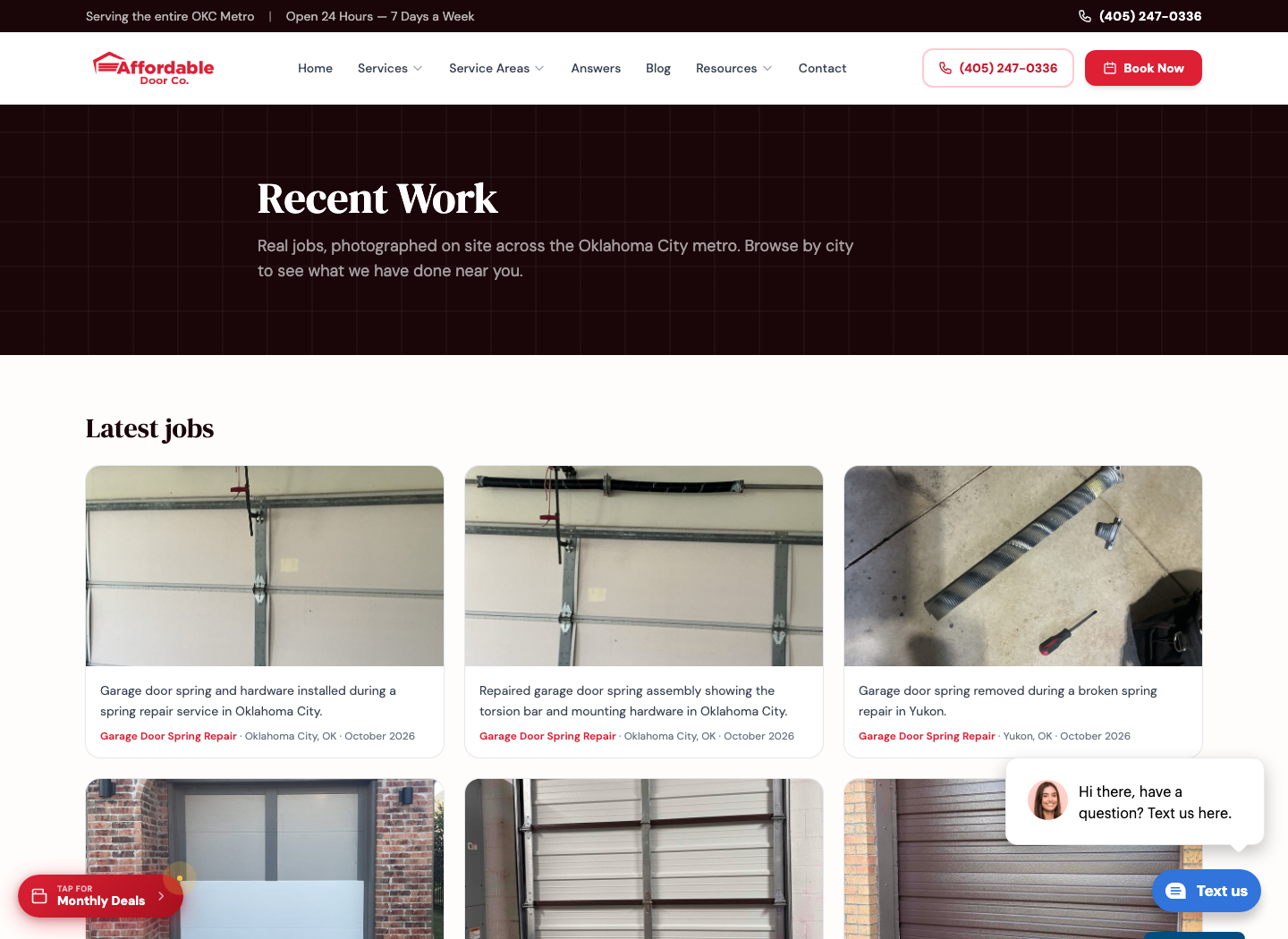
Published counts read from the site's own sitemaps and the live posting queue, 31 October 2026.
Capturing the web visitor
A form at 11pm wakes somebody up in ten minutes
1
It lands on the site
Estimate forms, the door designer, the booking flow and the phone taps all write to one place the company owns, on their own hosting. No lead sits inside a tool we could lose access to.
2
We read it every ten minutes
A job outside the website polls for anything new around the clock. The website never has to send an email itself, so a mail outage at the host cannot swallow a lead.
3
A pitch does not earn a text
A public form is also a public inbox, and cold-outreach software posts to it weekly. Every submission is classified first: a real lead, a solicitation, or junk.
4
The owner's phone buzzes
A real lead emails three people and texts the owner. A solicitation is emailed only — visible, in case the screen got it wrong. Nothing is ever deleted.
Running since 5 August 2026. The screen never deletes a submission and the website's own lead admin stays the complete record — so the filter can be wrong without anything being lost.
Describes the running system as configured on 31 October 2026.
Google and Facebook
The profiles post themselves, every single day
5.0 ★
1,934 Google reviews
Their reputation is their own. Our part is making the profile show the work: 246 posts published, 498 job photos uploaded.
Up to three Google posts a day, 9am to 6pm
Written from the job that was actually done. Facts only, no slogans. Google holds the schedule, so 83 days are booked ahead.
Up to three Facebook posts a day, 7am to 8pm
One job equals one multi-photo post, never the same photo three times. 299 finished jobs sit queued and editable.
Ten job photos dripped per run
Geotagged and renamed from the real job, filed to the right tab: exterior for a finished door, interior for opener and spring work.
Nothing posts that the owner cannot see first
The queue is human-editable, and everything is reviewable before it publishes.
Rating and review count read from the live profile, 28 October 2026. Post, photo and queue totals read from the running system, 31 October 2026.
The phone system
We can put the phones in, or work with the ones you have
1
Every call, in and out
Inbound and outbound, recorded and kept for two years — so a dispute, a complaint or a coaching question is a recording you can open, not a memory you argue about.
2
Transcribed, then read
Each one transcribed, typed — new lead, existing customer, vendor, wrong number — summarised in a sentence, and matched to the customer it belongs to.
3
Graded against your rubric
Scored on criteria you define and can change, with the strengths and the one thing to work on written out per call.
4
And it moves
That is the point of measuring it. This client's average went from 77.8 in August to 87.0 in October — nine points in three months.
Most door companies already record their calls and nobody listens to them. The recording is not the product — the grade, the reason it did not book, and the coaching conversation on Monday are the product.
Two-year retention is the standard we set up; storage and provider are configurable per client.
CSR call analysis
Every call recorded, transcribed and graded
2,452
calls transcribed
2,279
graded against the rubric
Every caller is matched against all of a customer's known phone numbers, not just the one on the file — so a long-standing customer ringing from a spouse's mobile is not counted as a new lead. That one correction stops paid-channel numbers from being quietly inflated.
Calls the AI receptionist answers are detected and routed to a callback queue, because the CRM files them as abandoned.
Average CSR score
77.8
Aug
85.5
Sep
87.0
Oct
Up 9.2 points in the three months since grading started.
Scores are out of 100, averaged per calendar month, read 28 October 2026.
Speed to lead
Every lead gets a clock, and the clock is honest
98.8%
of paid Google leads reached
505 of 511 Local Services leads in three months, 96.8% of them inside five minutes. This is the half of the funnel they are already winning.
Three things count as a lead waiting
An unanswered call, a call the caller gave up on after we picked up, and a paid Google lead. All three go on the same clock — 679 of them between August and October.
A customer who rings three times is one lead
Repeat dials collapse into one episode and the clock starts at the first ring — the least flattering choice, and the only one that matches how long the customer has actually been waiting.
And the leak it found: missed calls
Fewer than one in three unanswered calls was ever reached again, and most of those customers rang back on their own. That is now a named queue with one name in it today — not a number nobody knew.
Measured over 1 August – 31 October 2026 from the client's own call and lead records. Queue depth read 31 October 2026.
The rubric
What the grade is actually made of
| Criterion | Weight |
|---|---|
| Offered a solution and booked the appointment | 25 |
| Discovery of the problem or need | 20 |
| Handled hesitation, price or scheduling | 15 |
| Professional greeting and company branding | 10 |
| Empathy and rapport | 10 |
| Clear close and confirmed next steps | 10 |
Different work, different rubric
Inbound CSR calls average 84.6. Outbound follow-ups are scored on their own rubric and average 89.3, with voicemail drops filtered out before scoring so they do not drag the average.
333 calls that did not book, explained
Each gets a reason in plain English. The honest finding: most are not lost sales — wrong numbers, vendor cold calls and existing jobs. The real misses, like took the details but never offered a time, are what the manager works on Monday.
Read from the running system, 28 October 2026. Weights are configurable — your standard, not ours.
One graded call
A new lead, an estimate booked, and the one thing to fix
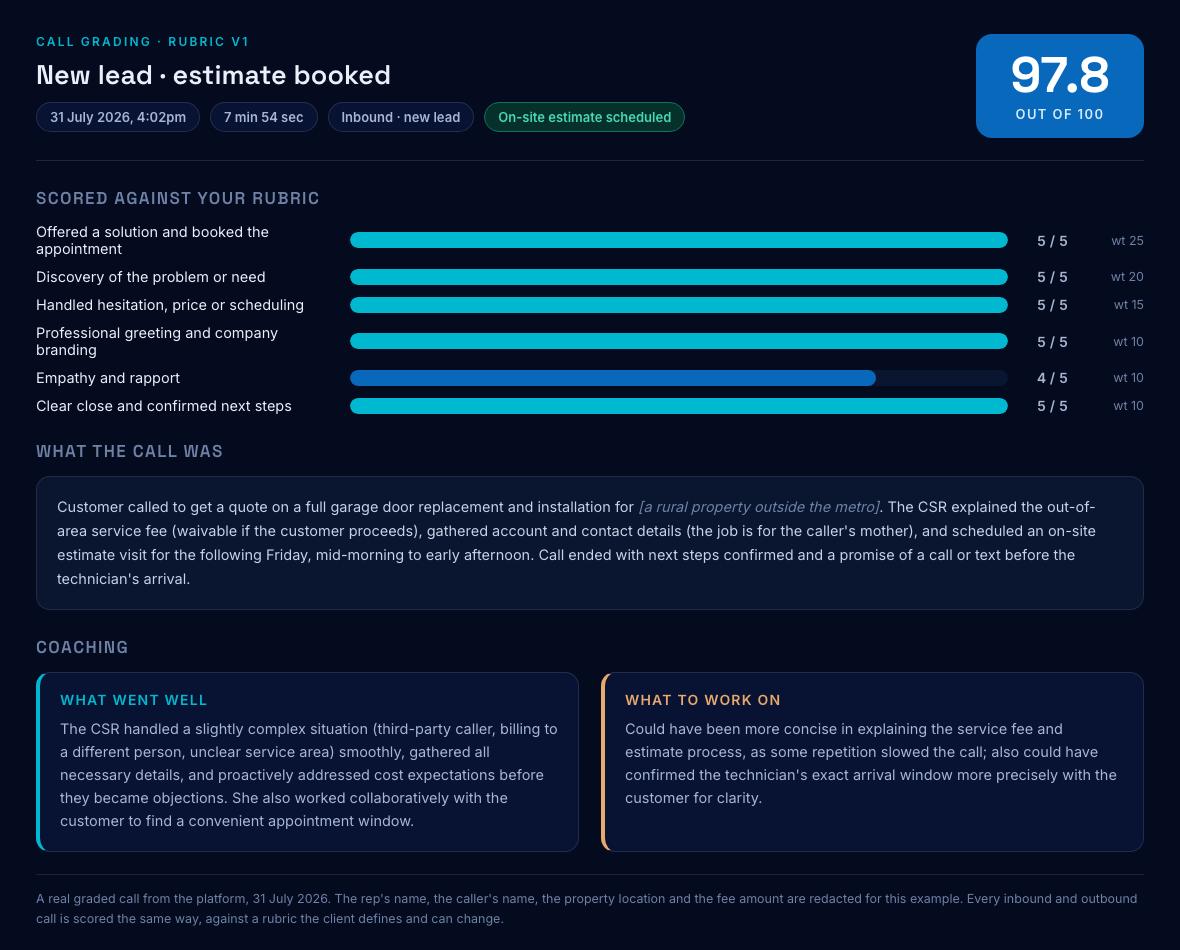
Seven minutes on the phone with somebody who found them online. The rep gathered the details, handled the fee question before it became an objection, and put an on-site estimate on the calendar.
It scored 97.8, not 100
Four out of five on empathy, five everywhere else. The grade is useless if everything is excellent — so it says what cost the point.
And what to do on Monday
“Could have been more concise explaining the fee… could have confirmed the arrival window more precisely.” Specific, about this call, coachable in a minute.
A real graded call, 31 July 2026. Rep and caller names, the property location and the fee amount are redacted here.
Coaching, delivered
7:30am, every weekday, to every rep
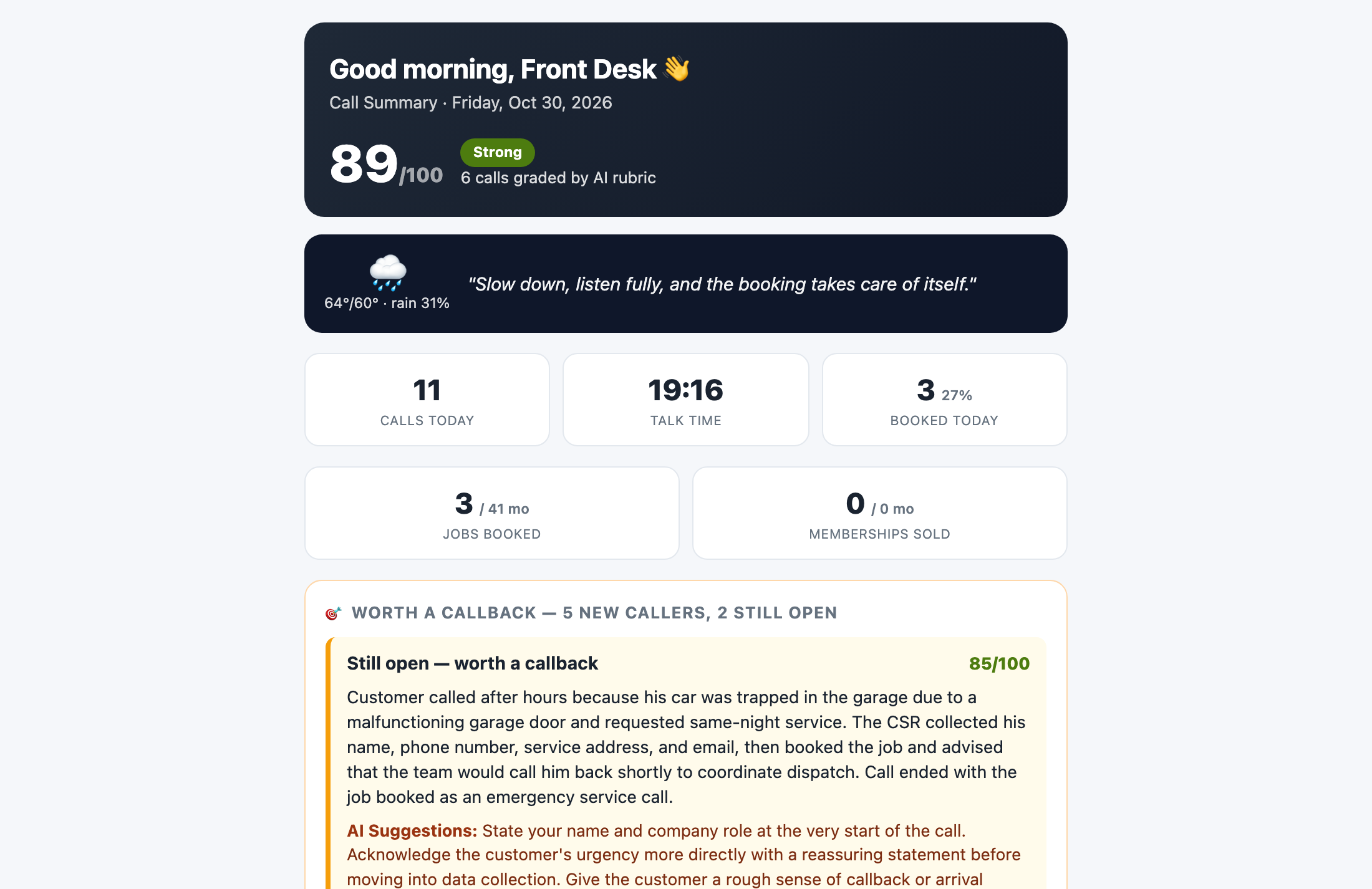
1 · The brief that arrives
Yesterday's score, calls graded, talk time, jobs booked today and this month — then the new callers who did not book, each with what to say when they ring back. Monday's covers Friday, Saturday and Sunday, so a weekend is never skipped.
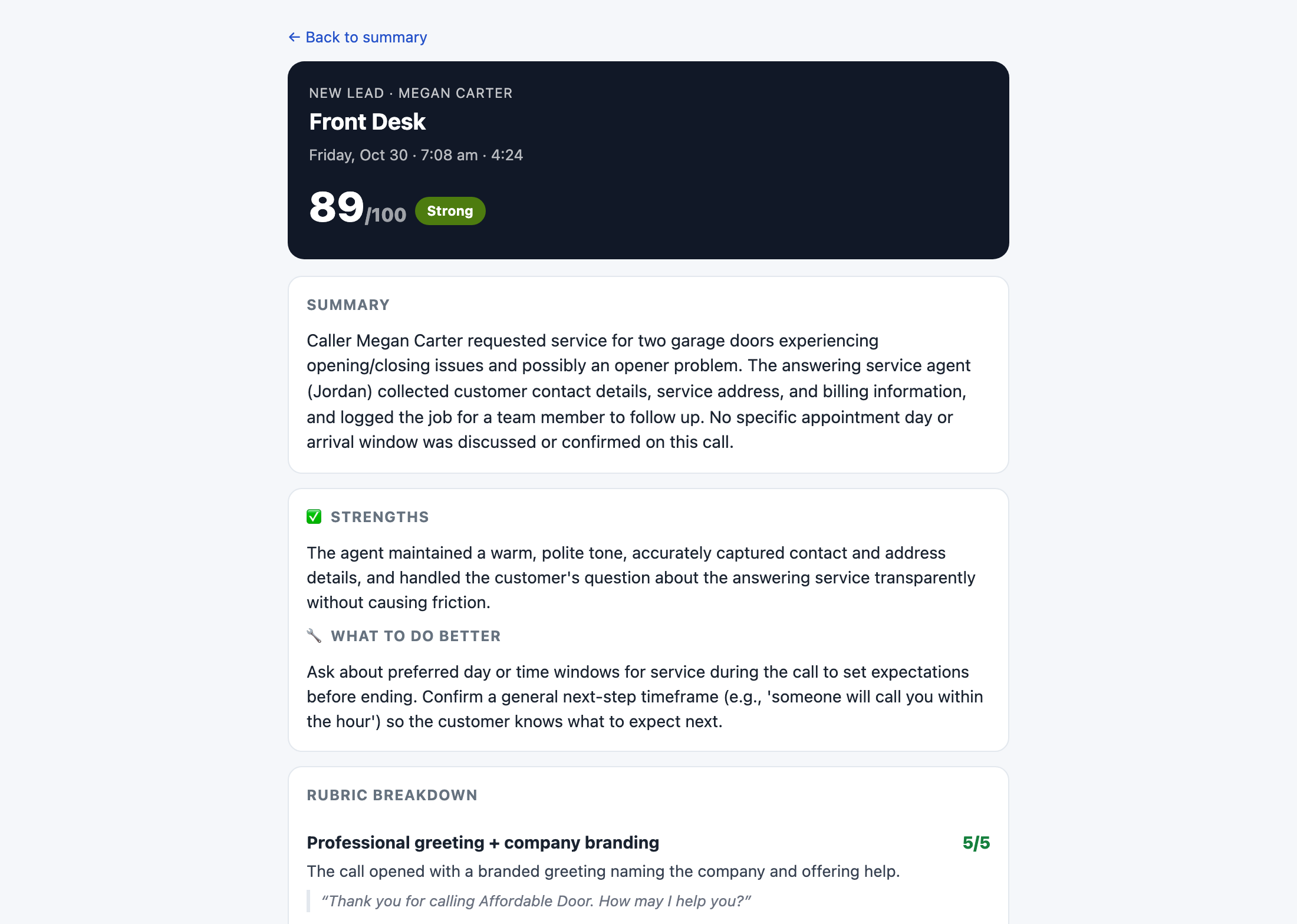
2 · Tap any call
What went well, what to do better, and the rubric scored line by line — greeting, discovery, empathy, the offer, objections, the close. Every score carries the sentence from the call that earned it, so nothing is a matter of opinion.
3 · And the week
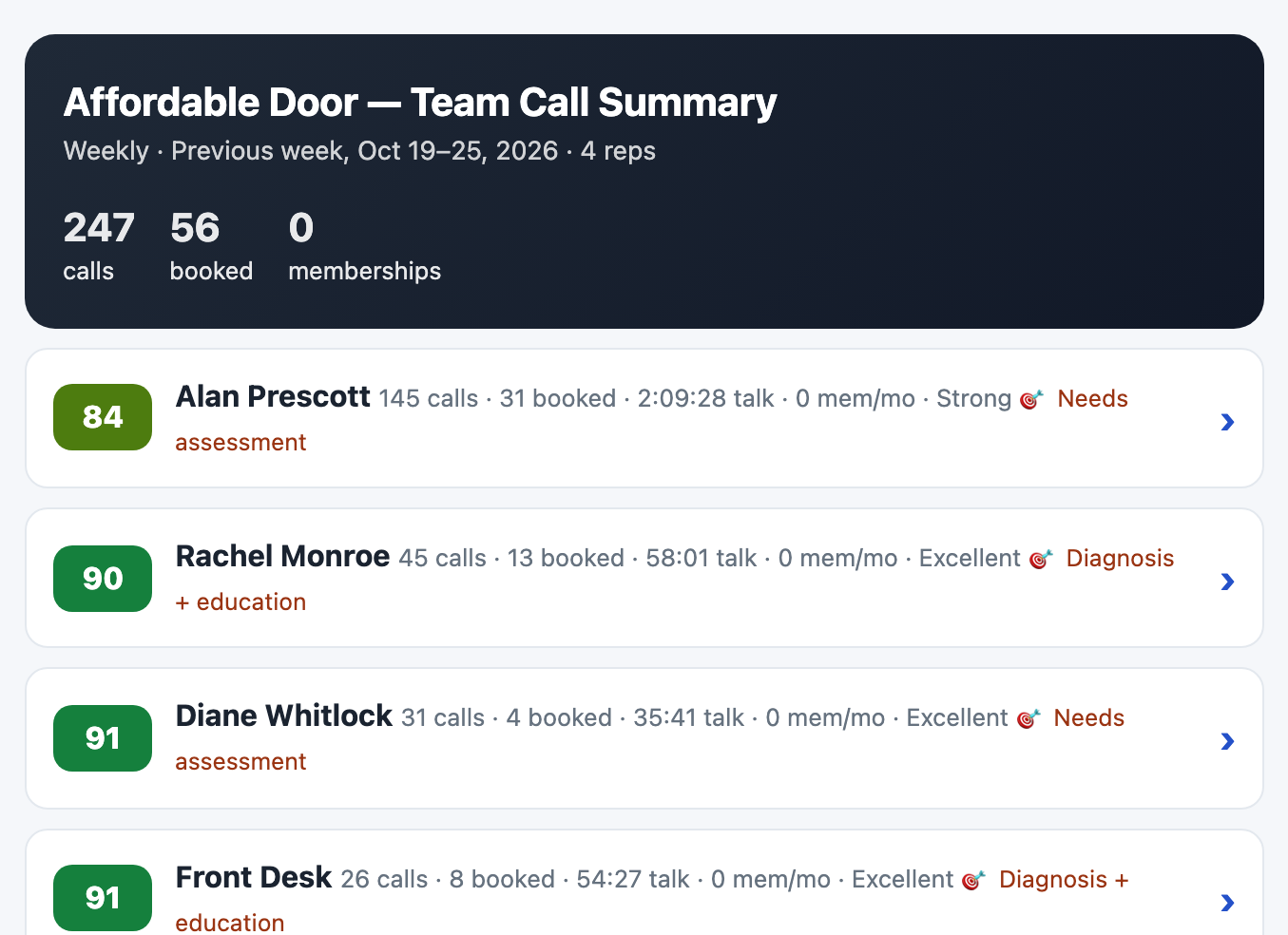
247 calls and 56 bookings across four reps, each with a score and one named thing to work on. The week's detail pages are the twenty lowest-scored calls — the coaching list, not a highlight reel.
Real briefs for this client, 30 October and the week of 19–25 October 2026. Links need no login and expire after 24 hours. Staff and customer names replaced for this deck.
Call analytics
Who is waiting on us, and how the phone is being answered
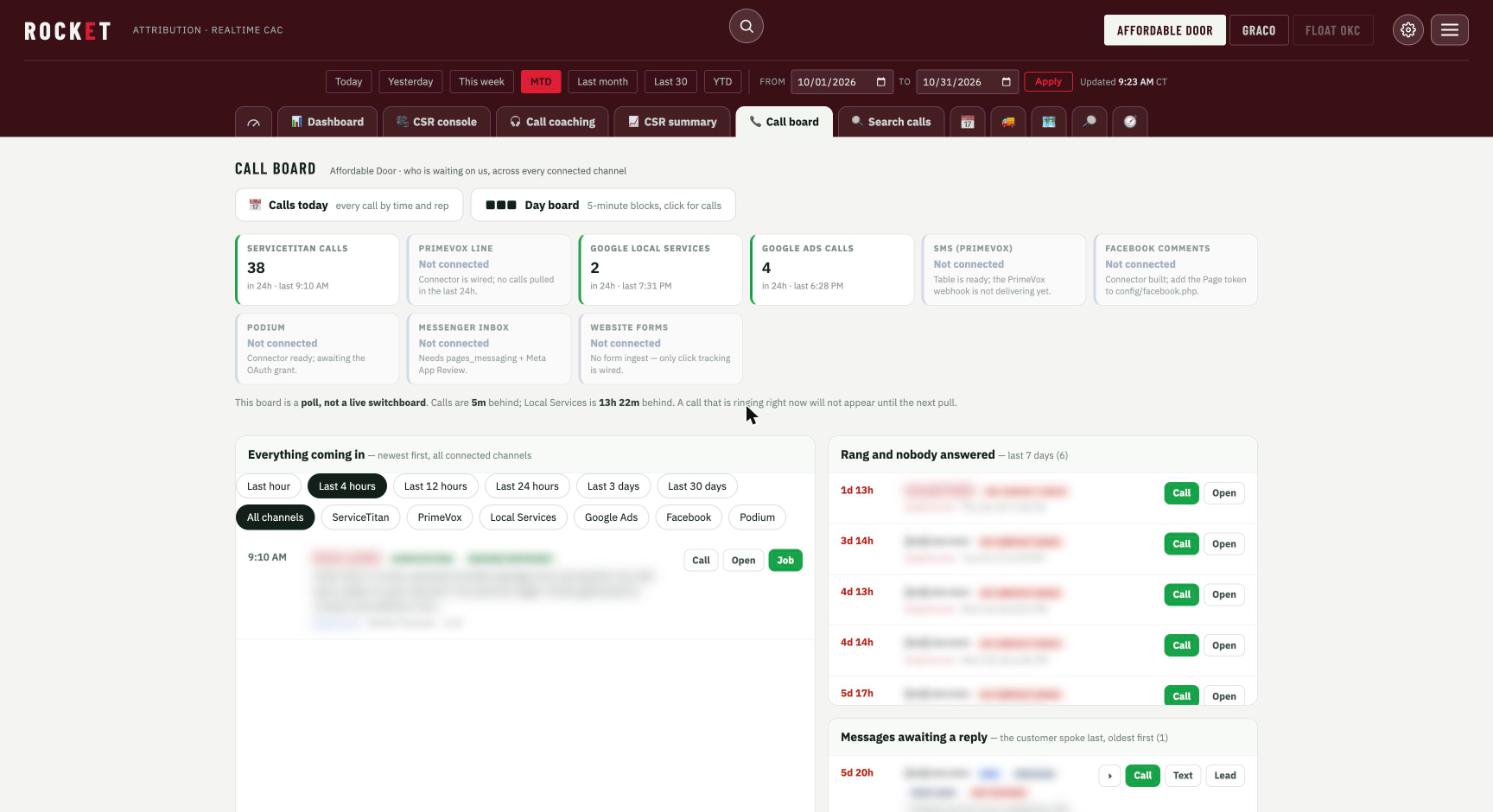
The call board — a work queue, not a report
Every connected channel across the top, then two lists: rang and nobody answered, and messages the customer spoke last on. Each row has a Call button. It says outright that it is a poll, not a switchboard, and how far behind each feed is.
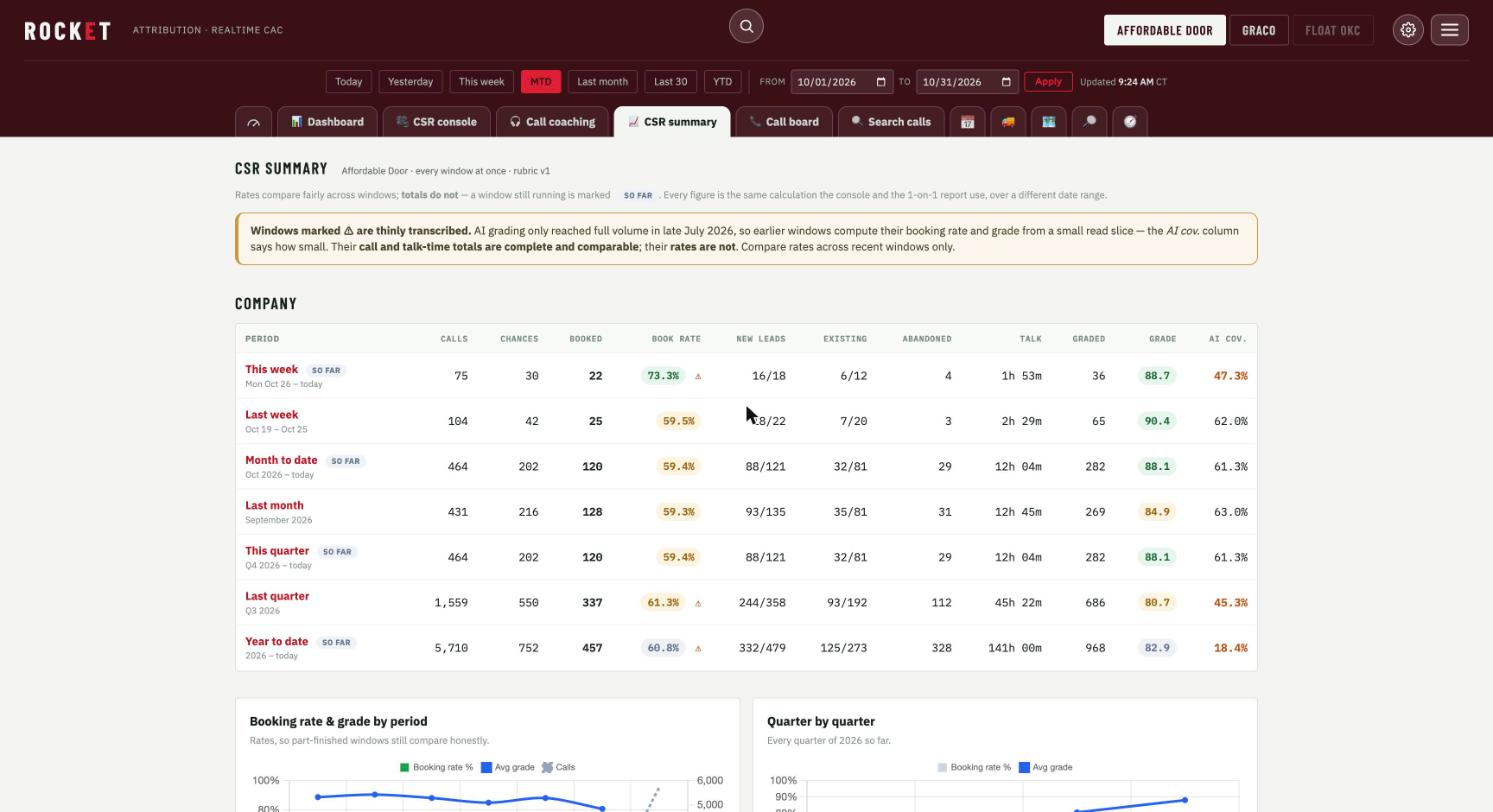
Booking rate, measured the same way every week
October to date: 464 calls, 120 booked from 202 real chances — a 59.4% booking rate, 282 calls graded, average grade 88.1. A part-finished week is labelled as one so it cannot be compared as though it were whole.
Both live pages, 31 October 2026, scoped to this client. Customer names, numbers and message text are blurred for this deck.
The platform
Spend in, revenue out, on one screen
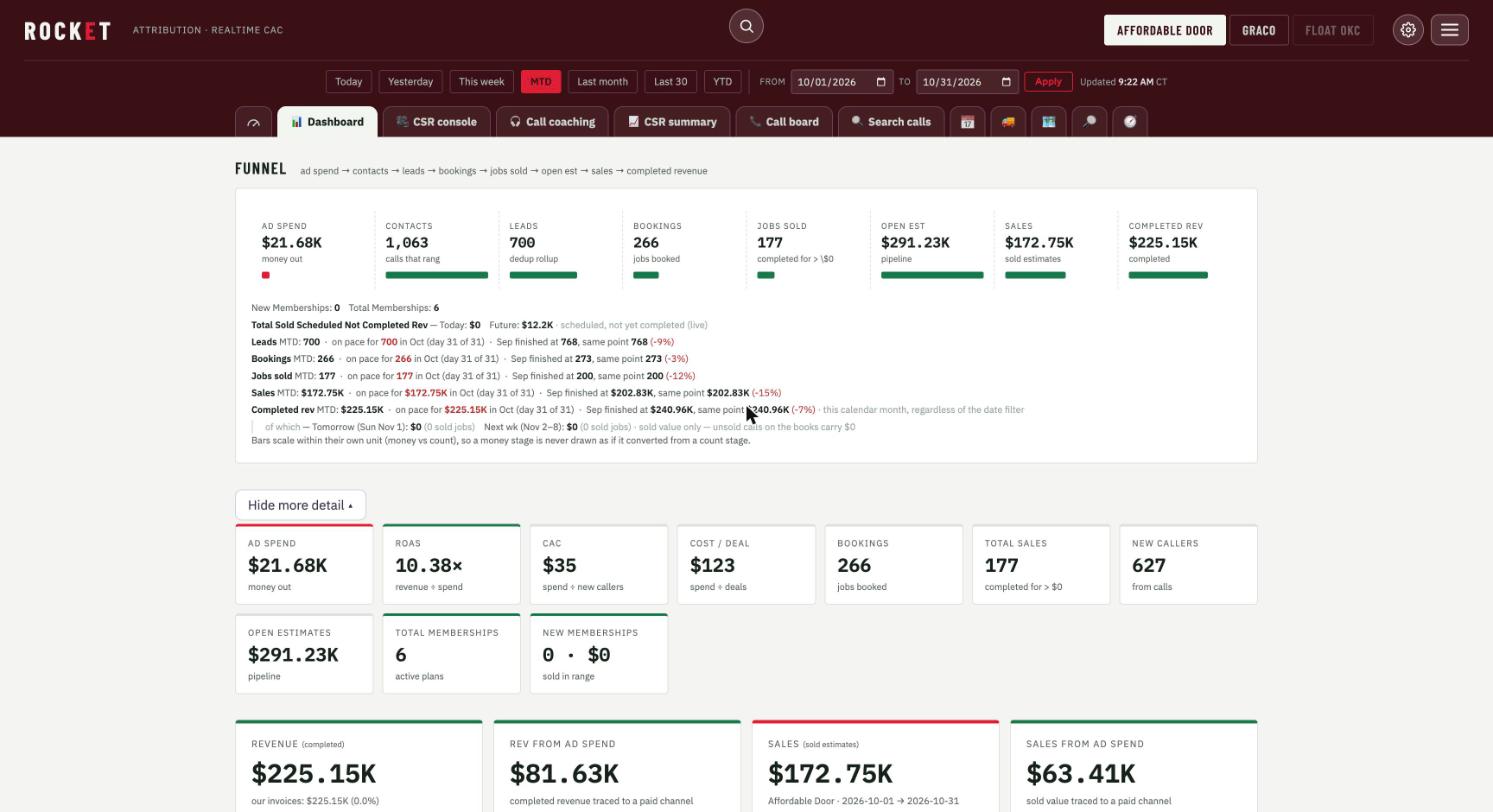
$35
per new caller
$123
per booked job
One rail, eight stages
Ad spend, contacts, leads, bookings, jobs sold, open estimates, sales, completed revenue — and every stage clicks through to the actual rows behind it.
Money and counts never mix
A bar is only ever drawn against its own unit, so a count stage can never be made to look as though it converted into a dollar stage.
The live page, 31 October 2026, scoped to this client: October to date — $21,680 spent, 1,063 calls, 266 jobs booked, 177 sold, $225,150 completed.
Two more boards
Every call scored, every campaign accounted for
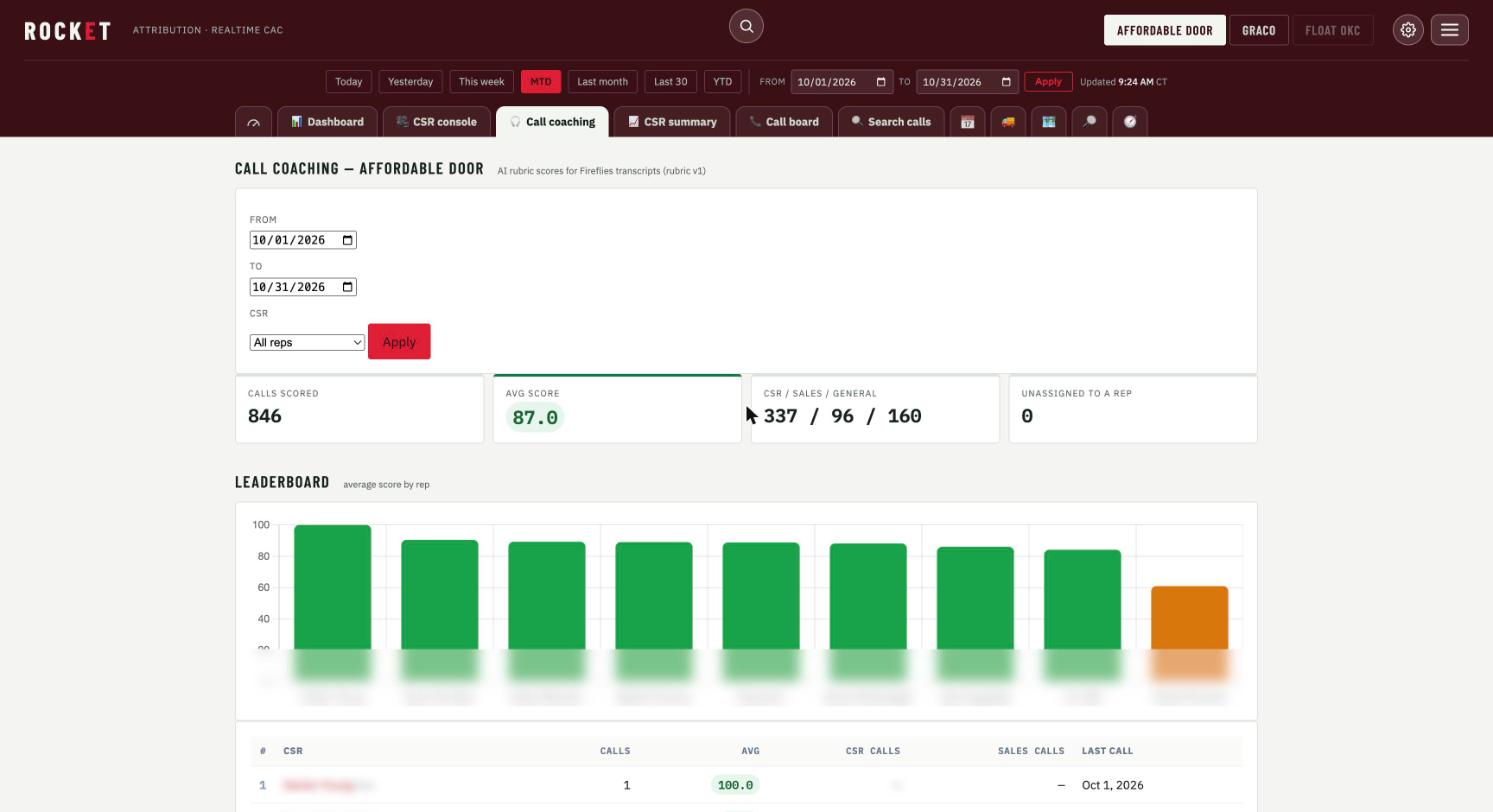
Coaching — 846 calls scored in October
Average 87.0 against the rubric, split by the kind of call: 337 front-desk, 96 sales, 160 general. Nothing sits unassigned to a rep, so no low score is anonymous and no good one goes uncredited.
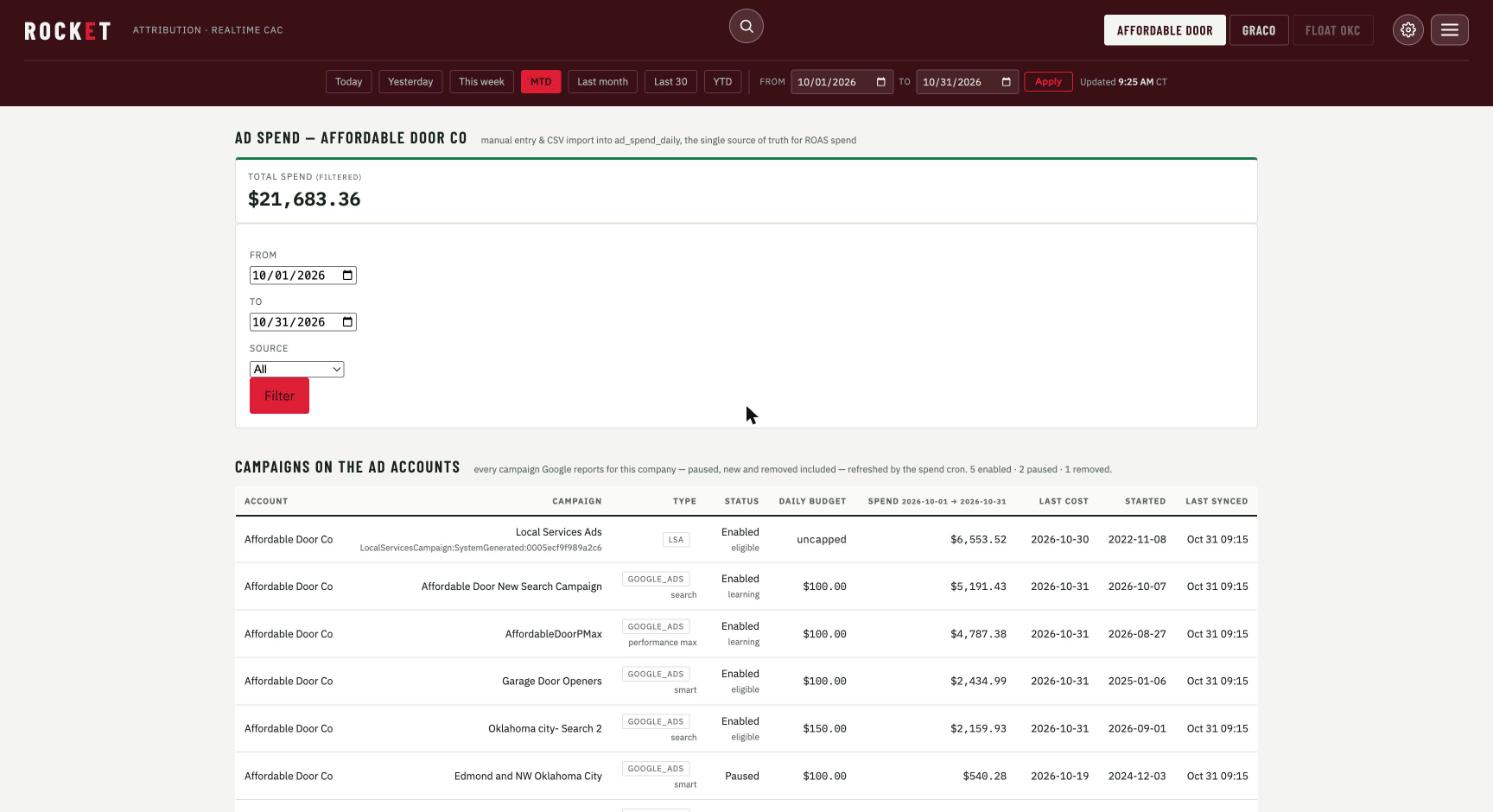
Spend — including what is switched off
Every campaign Google reports, paused and removed ones included, each with its budget, its spend and when it last synced. A campaign cannot quietly drop off the report just because somebody turned it off.
Both live pages, 31 October 2026, scoped to this client — $21,683 of ad spend across 8 campaigns in October. Rep names blurred for this deck.
Daily briefs
The owner reads the business before breakfast
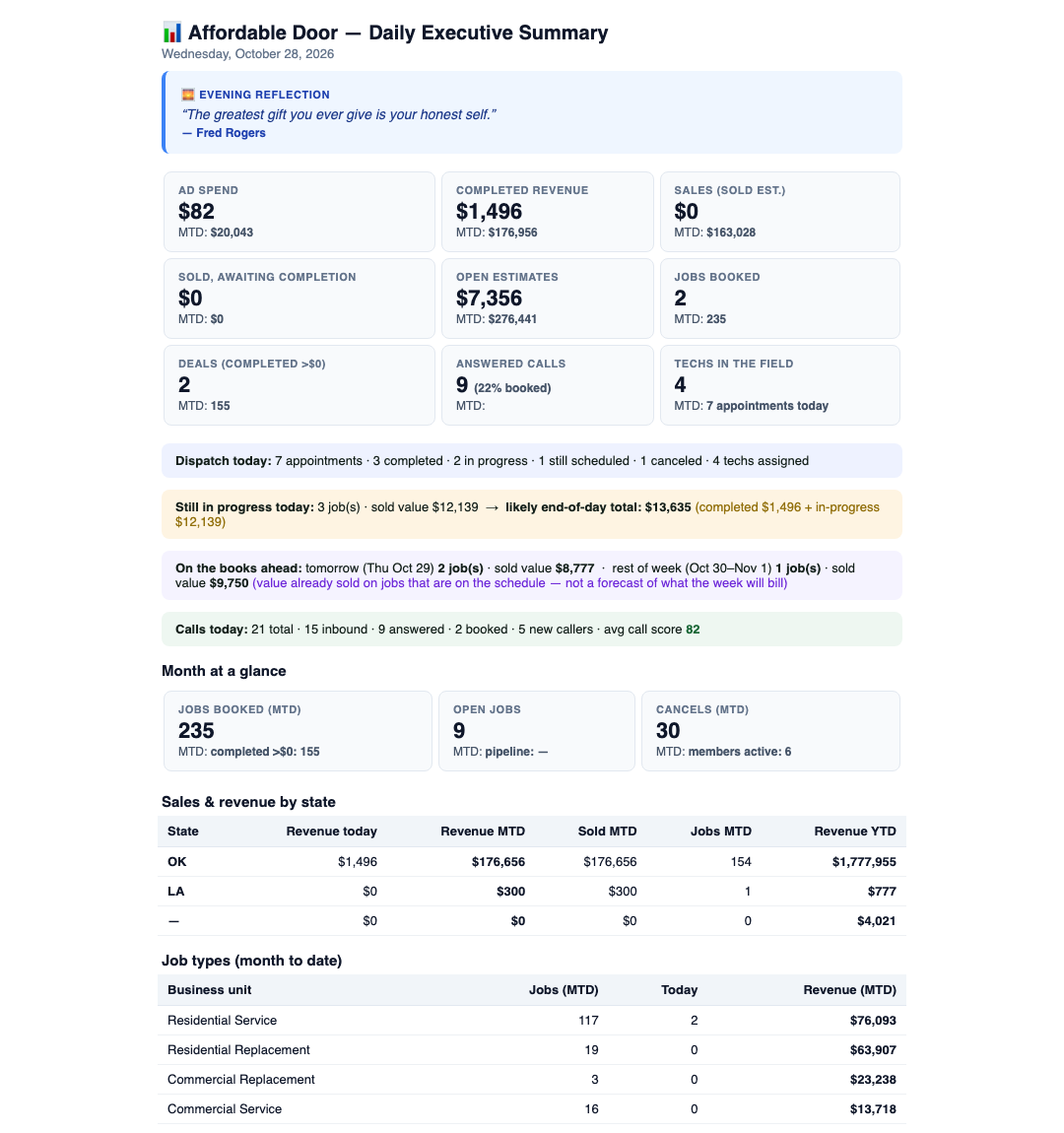
Morning — email at 5, text at 6:45
Overnight calls with summaries, today's schedule and who is assigned, revenue sitting on the schedule, month-to-date against pace, ad spend, the open-job backlog, and yesterday's unbooked leads with a link to each call.
Evening — email at 5, text at 5:05
Sales, revenue, jobs sold, calls taken, booked, spend, and what is on the books tomorrow and for the rest of the week.
The number is in the subject line
“Rev $7,407 · Spend $434 · 14 booked.” He opens it only when he wants the detail. Monday adds last week against the week before.
A real brief from production data, 28 October 2026. Per-employee sections cropped.
Inside the evening summary · a good day
Every call of the day, in the same email as the money
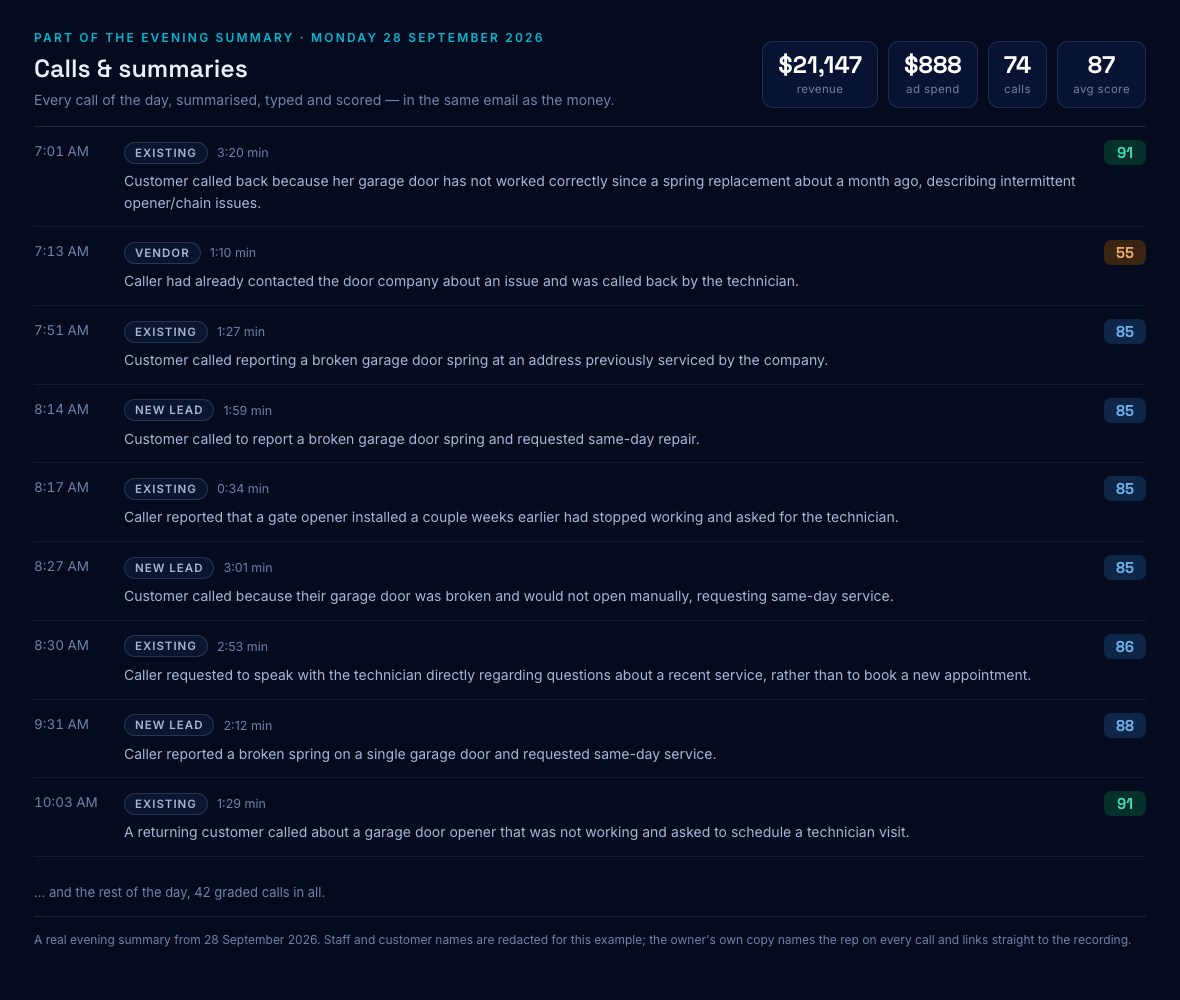
Monday 28 September: $21,147 of completed revenue on $888 of ad spend, 25 appointments, 74 calls. The owner's evening email carried all of it — and then listed every call.
42
graded that day
87
average score
Time, type, length, score, one line on what the caller wanted. An owner can read the whole day in a minute and open the two that look wrong — without listening to a single recording.
A real evening summary, 28 September 2026. Staff and customer names are redacted here; the owner's copy names the rep and links to the recording.
Follow-ups owed · sent every day at one
“We'll call you right back” — and nobody did
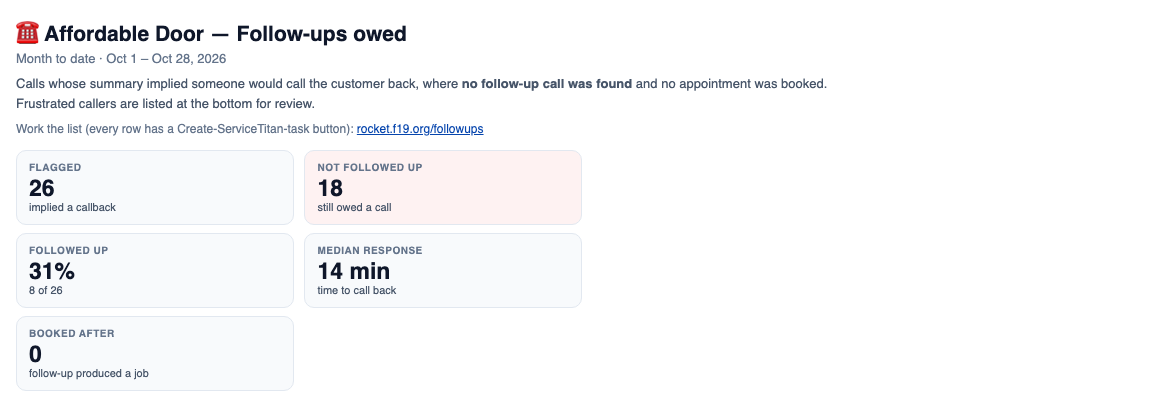
The system reads the promise
Every call summary is checked for a commitment to ring the customer back. Then it looks for the call that should have followed — and for a booking.
This month: 18 still owed
26 calls implied a callback. Eight got one, at a median of 14 minutes. Eighteen did not, and none of the 26 produced a booked job.
It is a worklist, not a telling-off
Each row carries the number, the summary, how long it has been owed, and a one-click button to raise the task in the CRM. The manager works it that afternoon.
Real report for 1–28 October 2026. The per-call rows beneath carry customer names and numbers and are cropped out here.
The platform
One screen that ties the spend to the money
Leads
Booked
Estimates
Appointments
Sold
Every stage clicks through to the jobs behind it
Cost per customer, per campaign
Spend against attributed revenue for each campaign, with cost per customer and return side by side — and a reconciliation report that lists spend with no revenue and revenue with no spend instead of hiding the mismatch.
How sure we are, shown
Each match carries a confidence level, from a confirmed same-call timestamp down to the CSR's own campaign pick. Unmatched calls stay in a real “Direct” bucket — never pushed onto a paid channel to flatter a report.
New callers kept separate
Existing-customer calls are split out of every funnel number, so a repeat service call never gets counted as an acquisition win.
Alongside it: dispatch and schedule boards, a map of the day's work, a lead inbox with one-click booking, a missed-call callback queue, an unbooked-lead worklist, per-rep coaching pages and a manager console — each role seeing only what it should.
Multi-tenant by construction: one client's data is scoped on every query, never shared across businesses.
Hiring · live on the client's own domain
A careers site and a real application, not a PDF in an inbox
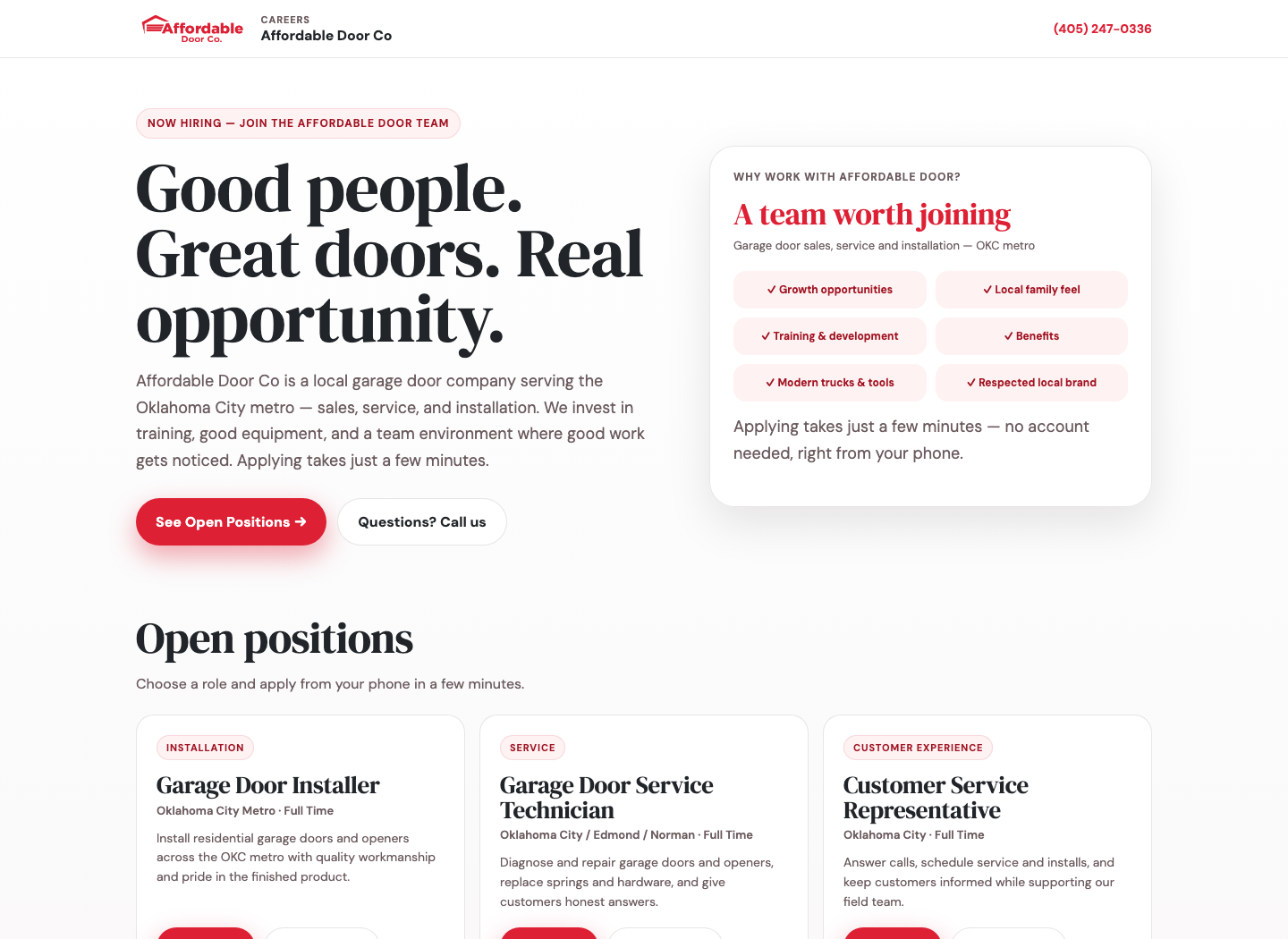
Four live roles — technician, installer, CSR, driver — each on its own page.
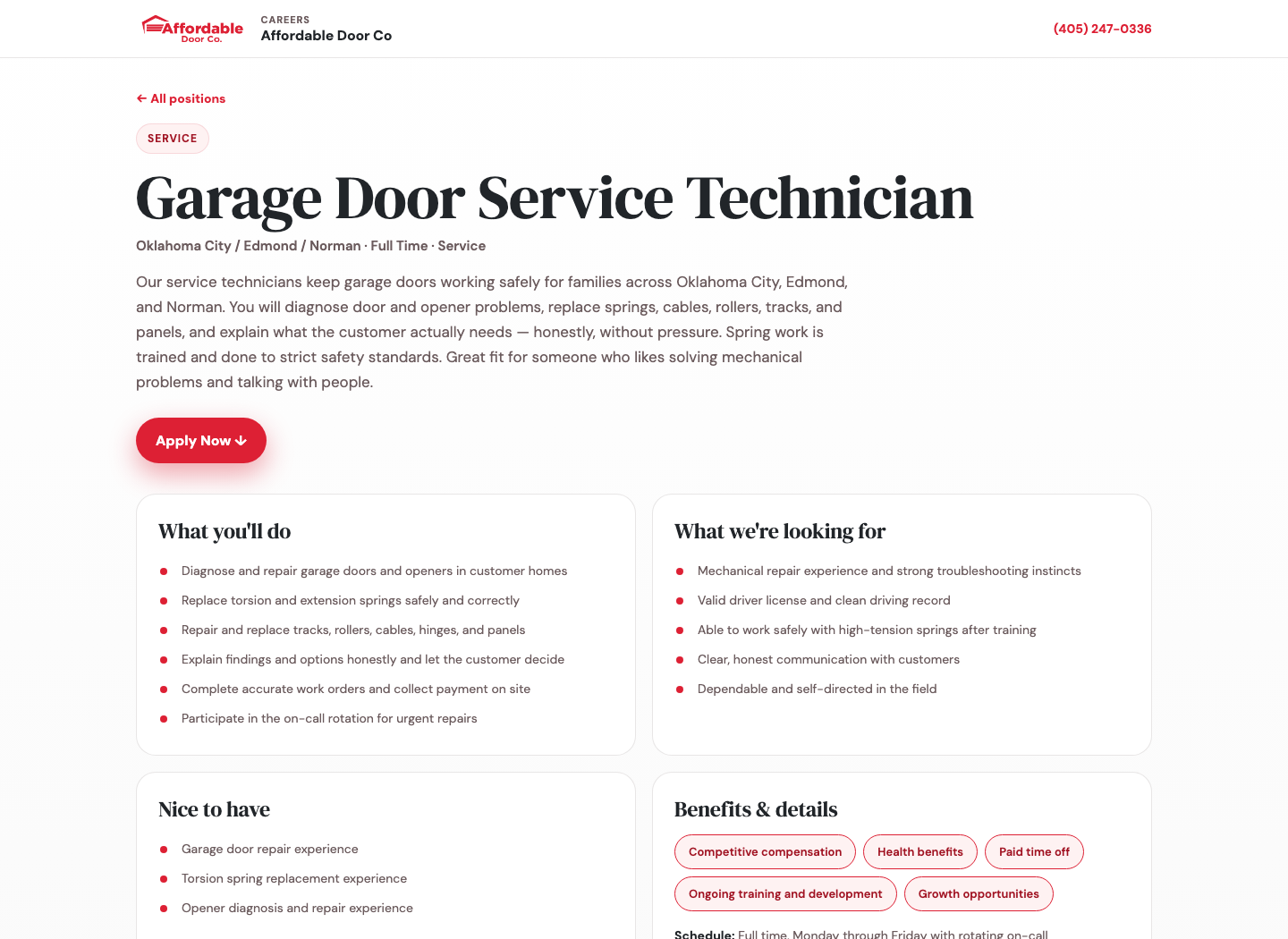
The role, then a five-step application built for a phone in a truck.
One person, many applications
Deduplicated on email and phone, so a tech who applies twice is one record with a history.
Worked, not just collected
Stages, notes, interviews and an activity trail, with new applications alerting whoever you nominate.
You run the postings
Open, edit and close roles yourself, with your own per-role questions. Background-check and payroll hooks are ready for your providers.
Captured from the live careers site, 28 October 2026. The internal applicant pipeline sits behind the client's own login.
“I have been in this business thirty years and I never had a straight answer on what my advertising was actually buying me. Now I open my phone in the morning and I know what came in, what it cost and what we sold. We are doing roughly twice the business we were doing in January with about the same ad budget.”
Ron Gregory
Owner, Affordable Door Co.
“The call grading changed how we run the office. We can hear exactly where a call went sideways and coach to it the same week instead of guessing. Our scores went from the seventies to the high eighties, and that shows up as booked jobs.”
Jim Bell
General Manager, Affordable Door Co.
Affordable Door Co. has worked with us since February 2026. Both are happy to take a call from anyone weighing this up.
Who you would be working with
Holarctic, built and run by Bluefrog
2026 Inc.
Power Partner
Inc.'s annual award for the B2B companies that business owners credit with their growth. Announced 20 October 2026.
Google Partner · Yelp Advertising Partner · Mailchimp Pro Partner
We build the software, not just the ads
The platform in this deck is ours. That is why the door designer, the call grading and the daily briefs all read from the same data instead of four disconnected tools.
Home services is the specialism
Garage doors, heating and air, plumbing and electrical. Across the platform we have logged more than 110,000 calls, transcribed over 11,600 and graded over 9,200.
Scottsdale, Arizona
Working with operators nationwide. Founded and run by Jeff Beasley.
Platform-wide call volumes read 19 October 2026.
Next step
Tell us a time that works
and we will show you yours.
Thirty minutes. We will walk your own phone calls, your own Google profile and your own ad spend through the same screens you have just seen — before you commit to anything.
1
Call or reply with two or three times
Any weekday. We work around your schedule, not ours.
2
We look before we talk
Your website, your Google profile and your listings, reviewed in advance at no charge.
3
You keep the findings either way
Whether or not you decide to work with us.
(480) 741-8081
Jeff Beasley · jeff@bluefrog.ai · bluefrog.ai