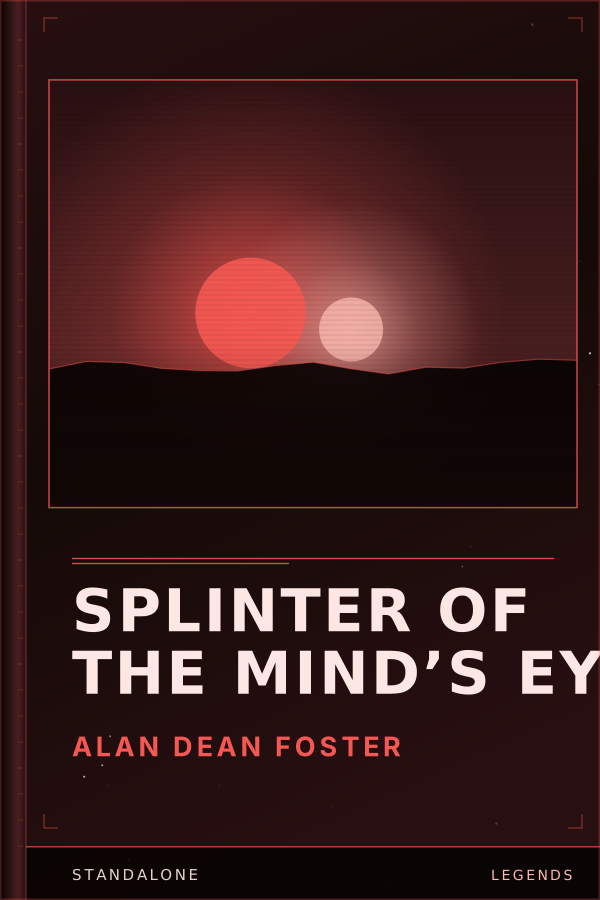
Everything that has ever been published under the Star Wars name traces back to this odd little paperback, and almost nobody would defend it as a novel. Both facts are worth sitting with.
The commission
In 1977 nobody knew whether Star Wars would work. Alan Dean Foster — who had already ghostwritten the film's novelization — was asked for a sequel that could be shot cheaply if the box office disappointed: limited cast, one planet, fog. That is not a rumour, it is the design brief, and it explains essentially every choice in the book.
What is actually in it
Luke and Leia crash on Mimban, a swamp world with an Imperial mining operation on it, and go looking for a Force artefact called the Kaiburr crystal. There is mud. There is a mine. There is a bar fight. Han Solo and Chewbacca are absent, because Harrison Ford was not under contract for a sequel. Vader turns up at the end.
Reading it in 2026
Two things are strange and one is instructive. The strange things: Luke and Leia's relationship is written with a romantic charge that The Empire Strikes Back and Return of the Jedi would shortly make unreadable, and the Force is treated as a much vaguer, more mystical proposition than any later text allows — closer to a psychic field than a defined power set.
The instructive thing is how small it is. Foster is writing pulp adventure on a single planet, and there is no sense whatsoever that this galaxy is a going concern with a history. Every later Star Wars novel is, in some way, a reaction against that smallness.
The prose
Better than the plot deserves. Foster is a professional and the sentences move; the descriptive writing about the swamp is genuinely atmospheric, and the mine sequence has real claustrophobia. What it lacks is any reason to care. Leia spends much of the book ill or captured. Luke is competent in ways the film had not yet established and would later contradict.
The duel
The famous problem: a novel written in 1977 has Luke fight Vader with a lightsaber and do reasonably well, which the actual second film would spend two hours establishing he cannot do. It is not the book's fault. It is a useful reminder that the Expanded Universe began before there was anything to expand.
Who should read it
Historians, completists, and anyone curious about what this franchise looked like before it knew what it was. If you are here for a good novel, go to Heir to the Empire instead — that is where Star Wars prose actually starts working.