A roundup is a useful discipline. Reviews are written one at a time, in the mood of the week, and it is only when you line them up that you find out what you have actually been arguing. So: a pass back over what is currently reviewed on the site, and what the pattern says.
The pattern
I appear to reward books about institutions. The titles I have been warmest about are, underneath their plots, novels about an organisation failing to see itself clearly — a Jedi Order that has mistaken procedure for wisdom, a navy that cannot promote the officer it needs, a government that won a war and has no idea how to run a budget. That is a real bias and readers should know about it before they weight my scores.
The prequel-era entries
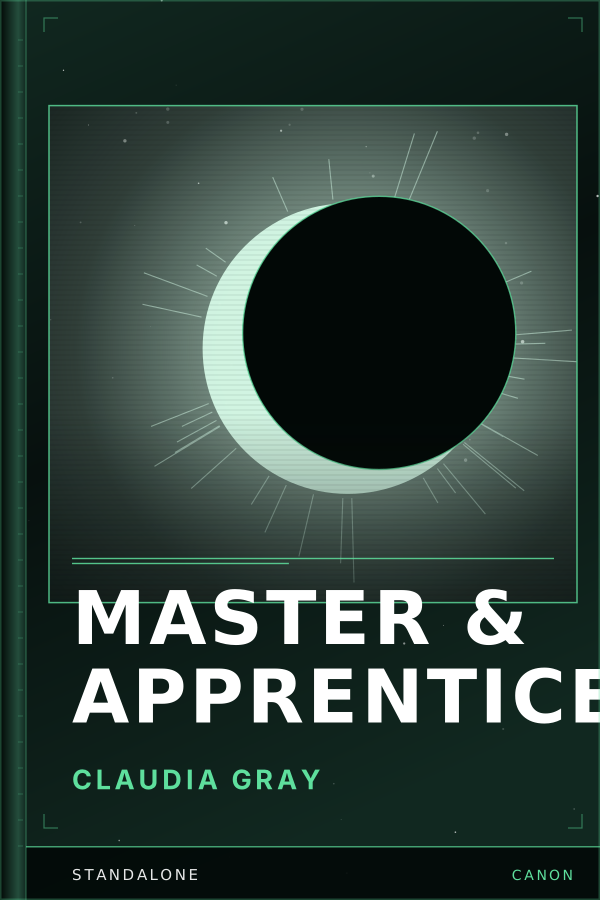
Claudia Gray’s Master & Apprentice (Del Rey, 2019) is the one I hand to people who say they do not read tie-in fiction: a mystery plot wrapped around an argument about prophecy and institutional authority that refuses to make either side stupid. Alongside it sit two very different books — James Luceno’s Darth Plagueis (2012), which is essentially a political history of the Republic’s corruption, and Matthew Stover’s novelisation of Revenge of the Sith (2005), which is the most stylistically ambitious thing on the shelf and got its own column.
Two Stovers at the top
It is worth admitting that two of the books I have graded most highly are by the same author — the Revenge of the Sith novelisation and Traitor (2002), his New Jedi Order entry. That is either a strong signal about his work or a strong signal about my taste, and I am honestly not certain which.
The two Thrawns
Timothy Zahn’s Thrawn (Del Rey, 2017) and Heir to the Empire (Bantam Spectra, 1991) are separated by twenty-six years and two continuities and are recognisably the same author solving the same problem. Both are reviewed here; they hold up for different reasons, which is a comparison worth its own piece — and got one.
Where the low scores are
They cluster in two places, and neither is a coincidence. The first is the earliest material: Splinter of the Mind’s Eye was written before the saga knew what it was, and it reads that way. The second is books doing structural work for something else — opening a trilogy, setting up a television series, bridging two films. A novel with a job to do for another product tends to come second in its own book.
What is still missing, and I know it
The reviewed shelf leans heavily on adult prose novels. Comics are barely represented — Dark Empire is the exception — and the young-adult shelf is thinner still, with Claudia Gray’s Lost Stars carrying it. The reference books are catalogued and largely unreviewed. The High Republic is barely touched. A catalogue that only covers the parts its keeper already liked is a blog with delusions of structure, so those gaps are the queue.
How to use the reviews
Read the verdict line, then the section on where the book strains, then decide. The scores are a sorting key and nothing more — I have written a whole column on why they should not be trusted with more responsibility than that. If you want a route rather than a ranking, the reading order tracks are built for that job.
Roundup of this site’s own reviews. All opinions here are the site’s.